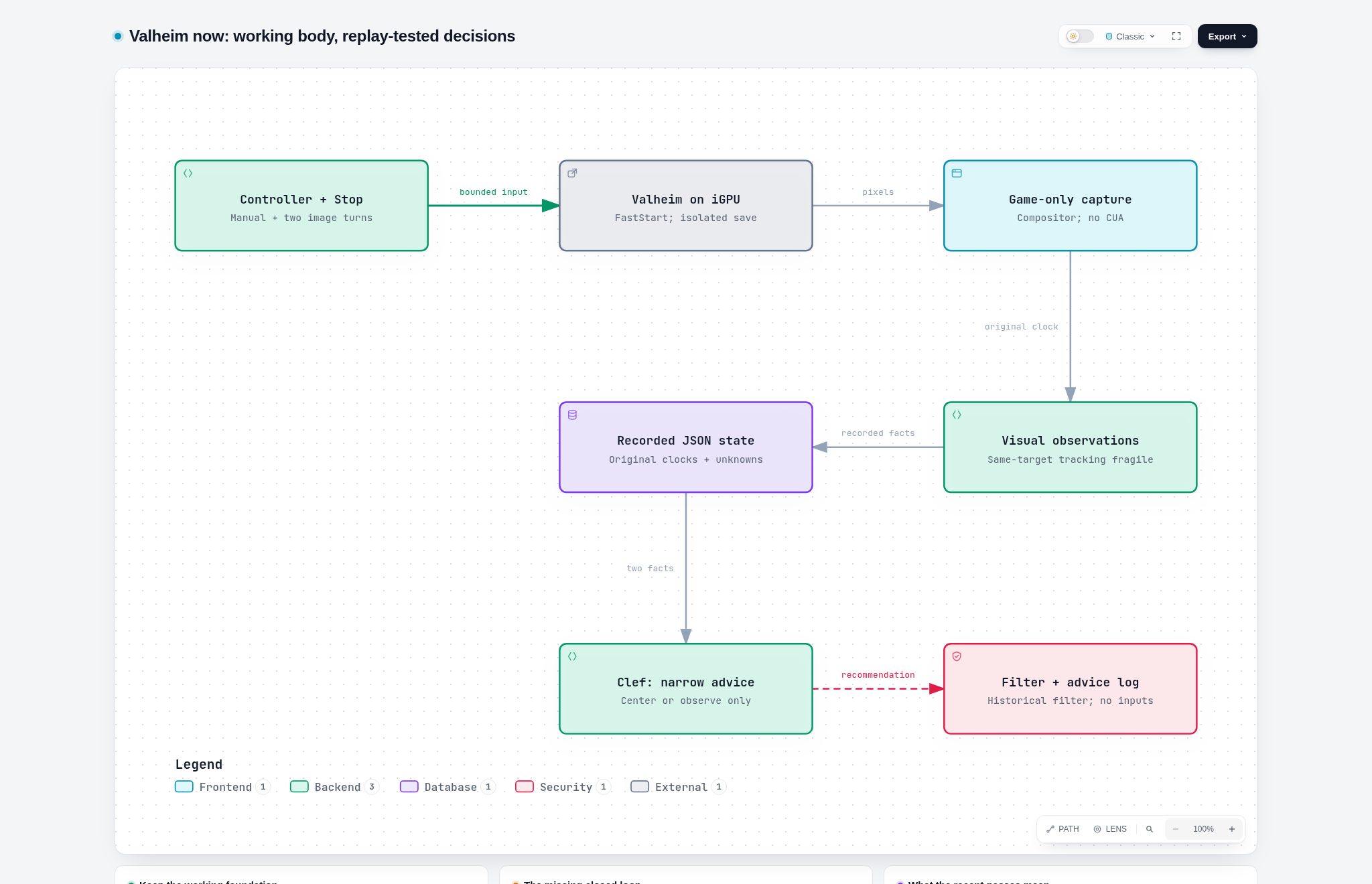
Current capabilities
Working body, replay-tested decisions
Inspect what is supported today and where live qualification is still missing. Open current diagram.
Evidence checkpoint ·
Select one stationary target from an image, center it, approach, and stop at a validated visual interaction-range cue. Then prove that a planner can direct that bounded skill.
The foundation and a small offline decision seam are proven. Full closed-loop centering, approach, and planner-directed play are not. This is not a claim of current gameplay capability; offline scores do not qualify live control.
Current capabilities
Inspect what is supported today and where live qualification is still missing. Open current diagram.
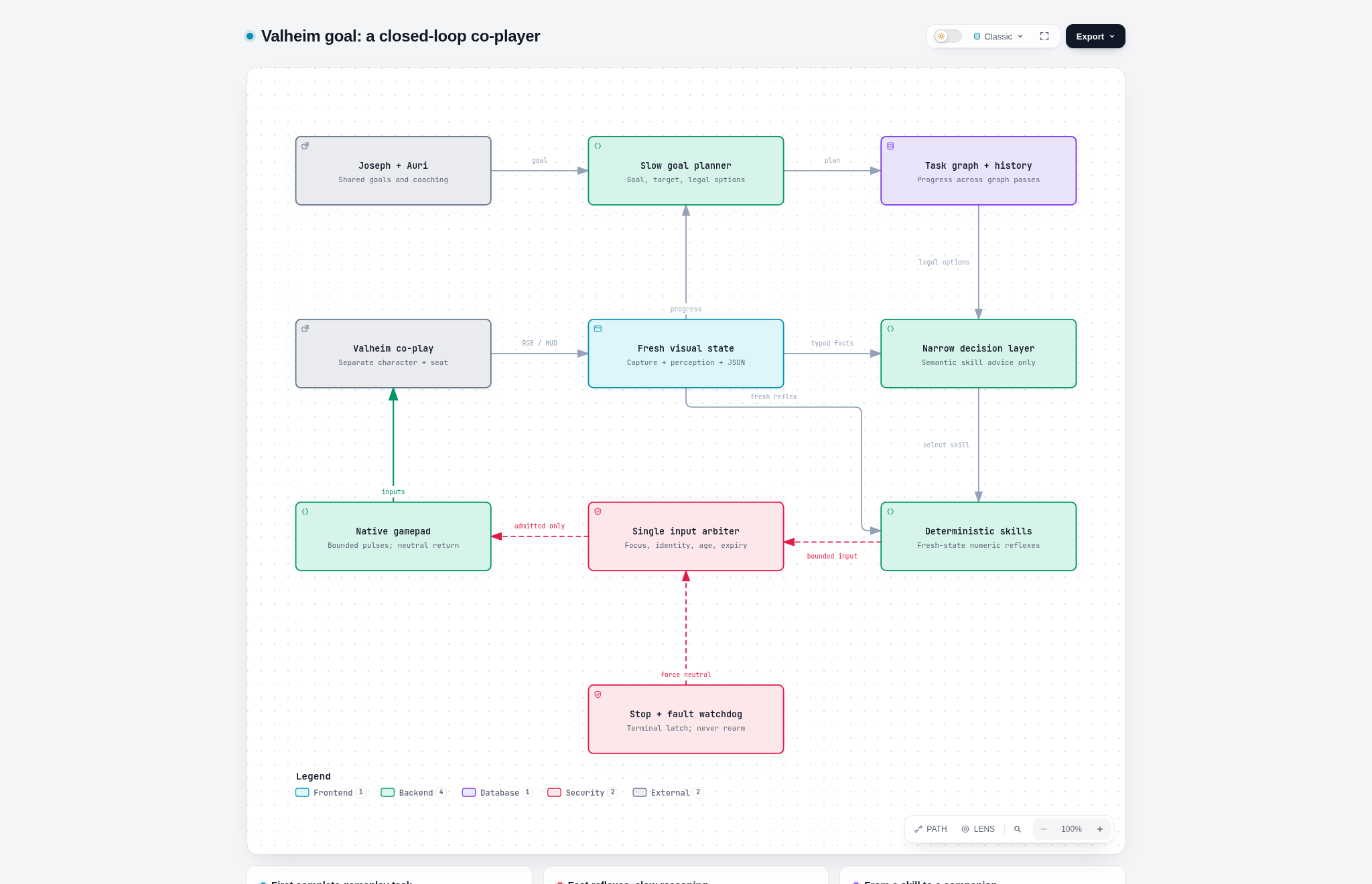
Desired architecture
A slow planner sets bounded goals; skills and the sole input arbiter own movement and timing. Open desired diagram.
Stages 1–6 define the currently frozen goal. Stage 7 is a separate, longer-term direction—not a claim that co-play is already qualified.
Observe without autonomous movement. Keep competing detector proposals, native-coordinate mappings, original clocks, actual focus/currentness, and completed recommendations inspectable.
Pass: Every state has truthful source identity and age. Unknown, stale, lost, or ambiguous evidence cannot authorize action; failed proposals remain inspectable.
A stationary shadow pass does not prove target identity through a camera turn.
Diagnose the recorded frame 45 ambiguity without inventing missing boxes; if needed, use one bounded diagnostic turn on the existing supervised baseline.
Pass: The same target remains identifiable, or control safely abstains. Each admitted pulse uses original source clocks and stays within the 200 ms capture-origin lease, with qualified source-to-actuator timing and Stop/expiry handling. Model or replay timestamps never refresh evidence.
The 144 ms decision-only median is not an end-to-end qualification.
Use deterministic centering with no forward movement.
Frozen pass criteria: Three attempts covering left, center, and right; target within ±3% of image width and neutral/in-band for 1 second. Each attempt takes at most 15 seconds and 12 pulses.
Acceptance criteria are frozen, not achieved.
Select a real stationary loose resource. Distinguish target-specific actionable range from distant hover text; calibrate visible-path safety with near, far, and occluded negatives.
Pass: A reliable visual range cue and clear-path evidence. Unknown cue or path prevents advance. A vision-only claim cannot use hidden engine coordinates.
Source-traced cue candidates exist; live calibration is missing.
Center, make bounded forward steps, reobserve after movement, and stop without pressing interact.
Frozen pass criteria: After at most 6 unscored calibrations, score at least 10 successes in 12 attempts across at least 3 targets and 3 viewpoint categories. Each attempt takes at most 60 seconds, holds the cue neutrally for 1 second, and has zero safety violations.
Acceptance criteria are frozen, not achieved.
A slow planner emits a bounded goal/target/options graph. A narrow decision model requests skills; deterministic skills and the sole input arbiter own movement and timing.
Pass: Repeat the same approach-and-stop task under planner direction. Stale graphs, targets, or frames, failed progress, and terminal Stop cannot cause unauthorized movement.
This completes the currently frozen project goal—not all co-play.
Incrementally qualify pickup/interaction, inventory and task memory, navigation/following, failure recovery, and shared-goal coordination. Auri uses her own character and isolated input seat.
Pass: Complete short shared tasks with independently verified outcomes and reliable pause, Stop, and recovery—without hijacking Joseph’s controls.
Longer-term product direction. No frozen aggregate acceptance score yet.
144 ms is the warm Clef decision-only median. 200 ms is the capture-origin lease for admitting a pulse, measured from the original source clock.
The decision-only number does not establish that the complete loop fits the lease. Source-to-actuator timing still requires qualification. Semantic advice stays outside per-pulse arithmetic; no model or replay timestamp can make old evidence fresh.
This ladder does not require rebuilding the existing launcher/capture, CUA menu driving, DMA-BUF/zero-copy, SLAM or metric world maps, or another undirected model sweep.